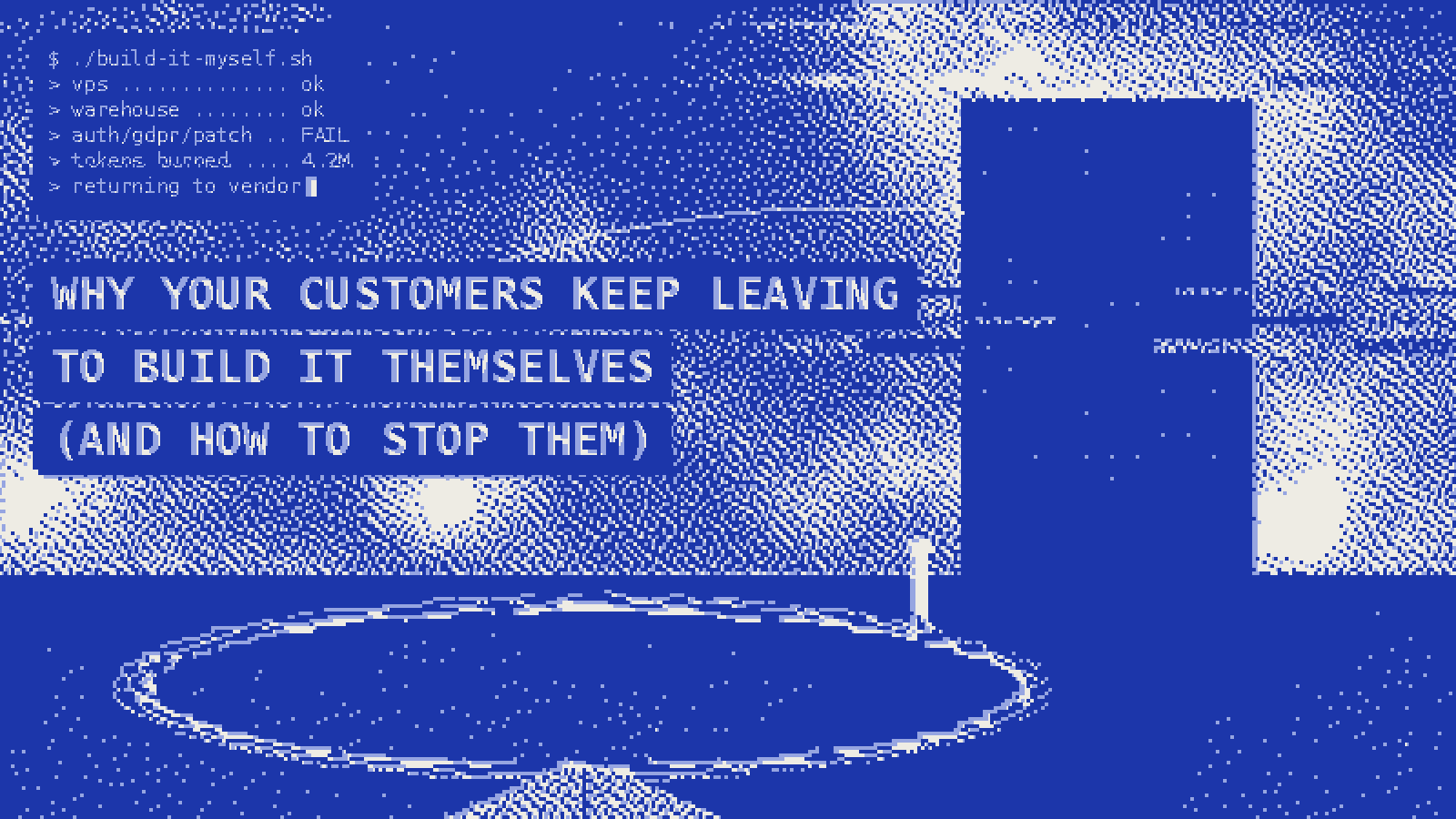
The loop
Across SaaS, the same loop keeps repeating:
- A customer uses your product.
- They leave to build their own with AI.
- They discover that data warehouses, hosting and security are still hard.
- They come back.
Step 4 looks like a win, but it isn’t. You lost revenue while they were gone and goodwill while they struggled. You also still haven’t fixed the reason they left.
Why they leave
Nobody leaves because they want to run a database. They leave because they hit a wall in your product. Maybe your UI can’t automate a workflow they need, or their data won’t connect to their AI tools, or they can’t run a job across 10,000 records.
AI makes a replacement look like a weekend project. The demo works, and that’s when they decide to go.
What a weekend project really costs
The demo is the cheap part. In production, the bills come from every direction:
- Hosting. A VPS, a database, backups, monitoring and, once the data grows, a warehouse. Each one is another monthly invoice.
- Tokens. Every rebuild, bug fix and new feature burns AI credits, and production usage multiplies them.
- Security. Authentication, encryption, patching and GDPR all become your job. One breach costs more than years of subscription fees.
- Learning. Hours go into DevOps instead of into the business you actually run.
- People. Eventually you hire someone to keep it running, and one salary dwarfs the software bill.
Then comes maintenance, which never ends. APIs change, dependencies break and new edge cases appear.
Even infrastructure specialists struggle with these costs. Railway founder Jake Cooper has said the company lost about $500K a month while it offered a free tier. The numbers only worked once Railway owned its own bare-metal data centres (Knuckle Up with Nakul). If the economics are that hard for a dedicated cloud company, they’ll be harder for your customer’s side project.
The subscription is the bargain
Once you add it all up, the monthly fee stops looking expensive. It pays for an engineering team, years of product decisions, hardened security and constant improvement, and thousands of customers share that cost.
Railway shows how much leverage that sharing creates. About 40 people serve more than 2 million developers, and the company is closing in on $100M in annual revenue. No in-house build can match that cost per user.
That’s why customers come back. They return out of pocket, and the limits that pushed them out are still there.
You don’t have users any more
Your customer used to be a person clicking around a dashboard. Now your customer is a person plus their agents plus their AI infrastructure, and the agents do more of the clicking every month.
Railway’s growth shows the shift. Its signups used to dip every summer, but this year the dip disappeared. Jake Cooper puts that down to people running agents in the background and firing off jobs from their phones. Each stronger model release has made the growth curve steeper.
Cooper expects 100 times more people writing 100 times more software, which is 10,000 times more in total. Every one of those agents needs a way into the tools it works with. A product that only has a dashboard is invisible to them.
Build agent-first
The fix for the loop is also the route to growth: make your product something agents can use.
- An MCP server lets AI assistants such as Claude and ChatGPT read your data, take actions and run workflows for the user.
- A CLI and a clean API let agents and technical users script anything your UI can do.
- Scoped permissions let customers give an agent exactly the access it needs. Cooper’s examples are access to one section of email, or a $1,000 spending limit.
- Events and webhooks let agents act the moment something happens, such as a new support ticket arriving.
Railway has already rebuilt itself this way. It now ships an agent in its dashboard, a CLI and an MCP server. A single SSH command gives you a working virtual machine, without even signing up. It’s also teaching AI models to recommend Railway and to operate its infrastructure directly. Your next customer may well be chosen by an agent.
Customers get everything that building it themselves promised, without the hosting, security or maintenance. You keep running the hard parts.
From churn risk to power user
Railway has an internal saying: software development is solved, but software engineering has never mattered more. Agents can now build a feature, ship it to production behind a feature flag, watch the monitoring and pick up support tickets. Cooper calls that whole lifecycle completely automatable.
Once customers wire your product into that loop, it stops being a tool they log into and becomes infrastructure they depend on. A report becomes one prompt, a monthly chore runs overnight, and bulk jobs your UI was never built for finish in minutes. Every workflow built on you raises usage and switching costs together.
The work doesn’t happen in the dashboard any more. Don’t compete with AI. Make your product the thing it runs on.